Reading the Pre-raphaelites: Revised Edition 2012 by T. J. Barringer
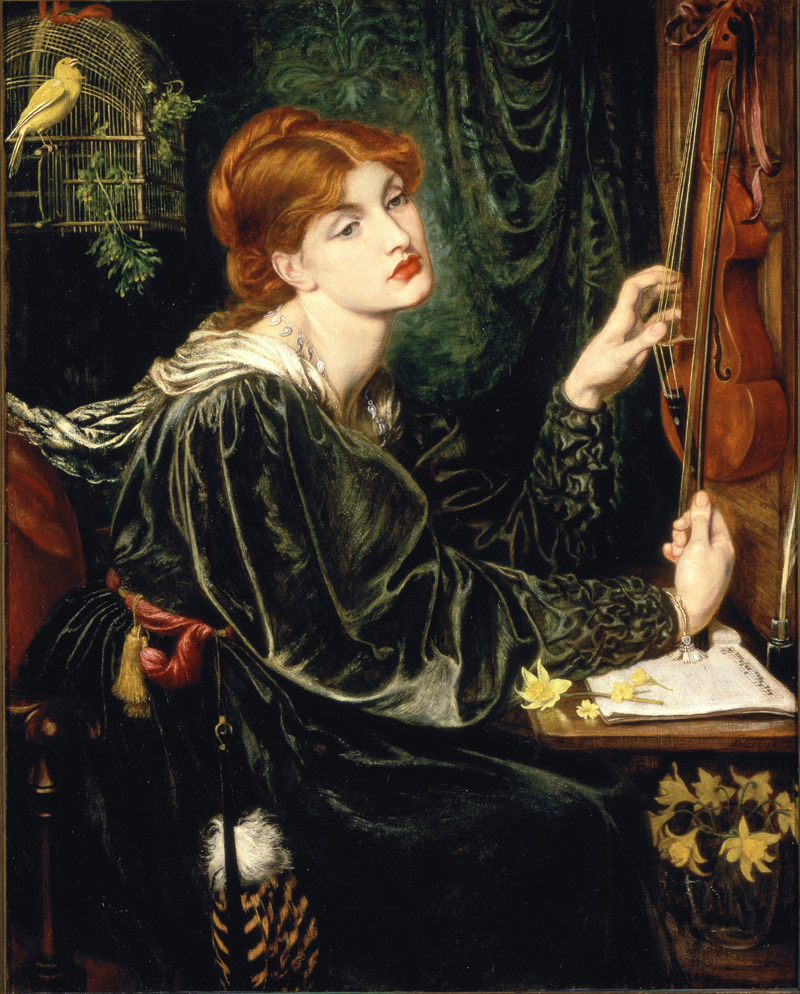 Dante Gabriel Rossetti (1828–1882), Veronica Veronese (1872), oil on canvas, 109.2 × 88.9 cm, Delaware Art Museum, Wilmington, DE (Samuel and Mary R. Bancroft Memorial, 1935). Courtesy of Delaware Art Museum, via Wikimedia Commons.
In that location was a lot happening in European painting in the middle and late nineteenth century, from about 1840 onwards. General accounts focus on French republic, simply there were merely as major changes happening in Deutschland, Italy, Britain, and the rest of Europe also.
With the simplification enforced by major textbooks of art history, accounts of painting in U.k. run something like: Lawman, Turner, Pre-Raphaelite, then the twentieth century. From virtually 1860, nothing interesting seems to take happened, maybe information technology was all but 'academic', or various iterations on a Pre-Raphaelite theme.
This article is role of a serial in which I try to become ameliorate insight into how non-impressionist painting changed from 1840 to 1900, mainly that in Britain. Here I volition take one of the virtually prominent and radical painters, Dante Gabriel Rossetti (1828-1882), and trace changes across but half a dozen of his more of import paintings, to try to become some clearer insight. Subsequent articles will look at his contemporaries.
PRB
The Pre-Raphaelite Brotherhood (PRB), the airtight group which formed the initial kernel of the whole movement, was established in 1848, and lasted barely five years to 1853. Its founding concept was that art (painting, in particular) since the time of Raphael had become misguided, and had abandoned the 'unproblematic honesty' which had prevailed in the fifteenth century (1400s) and before. The aim was therefore to become true to nature again.
Paintings of the Brotherhood (and many of the broader and longer-lasting motility) characteristically used vivid colours, had flat surfaces, and included objects and figures which were painted from nature, and not idealised in whatever way. As Ruskin wrote:
"they will depict either what they run across, or what they suppose might take been the actual facts of the scene they desire to stand for, irrespective of whatsoever conventional rules of movie-making."
This was primarily a defection confronting the many artificialities which had arisen in composition, reaching a peak, they felt, in the work and teaching of Sir Joshua Reynolds.
This did not make the Pre-Raphaelites strict realists, who could but paint what they saw. Indeed, many of their paintings characteristic the elaborate use of symbols, which were sometimes explained in accompanying text, and required decoding in order to 'read' the painting – and Pre-Raphaelite paintings well-nigh invariably require conscientious and detailed reading, sometimes at multiple levels.
Rossetti i
Two of Rossetti's early on oil paintings are good examples of this strictly Pre-Raphaelite art.

The Girlhood of Mary Virgin (1848–ix) contains some primitive devices, such as the gilt and lettered halos, and an oddly-proportioned affections, merely shows what Rossetti envisaged might have been the pictorial reality of the Virgin Mary during her youth. She works on embroidery with her mother, Saint Anne, while her begetter, Saint Joachim, prunes a vine.
Those details are shown quite realistically, as are the abundance of symbolic objects. The latter include palm fronds on the floor (the Passion), a thorny briar rose (Christ'southward suffering and death), lilies (purity), books (labelled with faith, hope, charity, fortitude, etc.), a dove (the Holy Spirit, the Annunciation), red cloth (the Passion), crosses in trellis (crucifixion), and more.

Ecce Ancilla Domini! (The Annunciation) (1849–50) is as radical a reinterpretation of the traditional Annunciation painting, equally The Girlhood of Mary Virgin was of the life of the Virgin. There are gilt halos again, amongst very natural realistic depictions of the figures and objects.
Symbols shown include: white robes (purity), lily (purity, a traditional Announcement symbol), a pigeon (the Holy Spirit), carmine embroidery (Christ'due south crucifixion), blue curtain (heaven), and flames at the feet of the Angel Gabriel rather than traditional wings.
Both of these paintings lucifer the profile of the strict Pre-Raphaelite.
Rossetti two
Less than a decade later, though, Rossetti painted a work which was completely different in almost every respect from those early works: Bocca Baciata (1859).

Bocca Baciata, which means the mouth that has been kissed, is an unashamedly sensuous portrait of Rossetti's mistress, Fanny Cornforth. Information technology was accompanied past a line from Boccaccio's Decameron, Bocca baciate not perda ventura, anzi rinova come fa la luna, which translates as
The mouth that has been kissed does non lose its promise, indeed it renews itself just as the moon does.
By modern standards, it may not appear particularly sensuous or shocking. At the time, her loose hair, unbuttoned garments, and the affluence of flowers and jewellery were seen as marks of the temptress. These are reinforced by the one obvious symbol: the apple tree, harking dorsum to the Fall of Homo. Staid viewers such as Holman Hunt were shocked, writing
It impresses me as very remarkable in power of execution – but still more remarkable for the gross sensuality of a revolting kind, peculiar to strange prints
by which he referred to imported pornographic prints.

Fanny Cornforth appears again in The Blue Bower (1865), a step fifty-fifty further from the PRB. Her eyes at present directed at the viewer, her hair is still loose and her clothing open and inviting. Her hands are idly caressing the strings of an instrument which is exotic and oriental: Rossetti probably did not know, only it is a Korean koto, and refers to some other sense (hearing) and mode of art (music).
Cornforth is surrounded past passion flowers, the decorative blue groundwork alluding to their heavy scent, and the sense of smell. The delicate light blue cornflowers in the foreground are probably simply a visual pun on Fanny'southward surname.
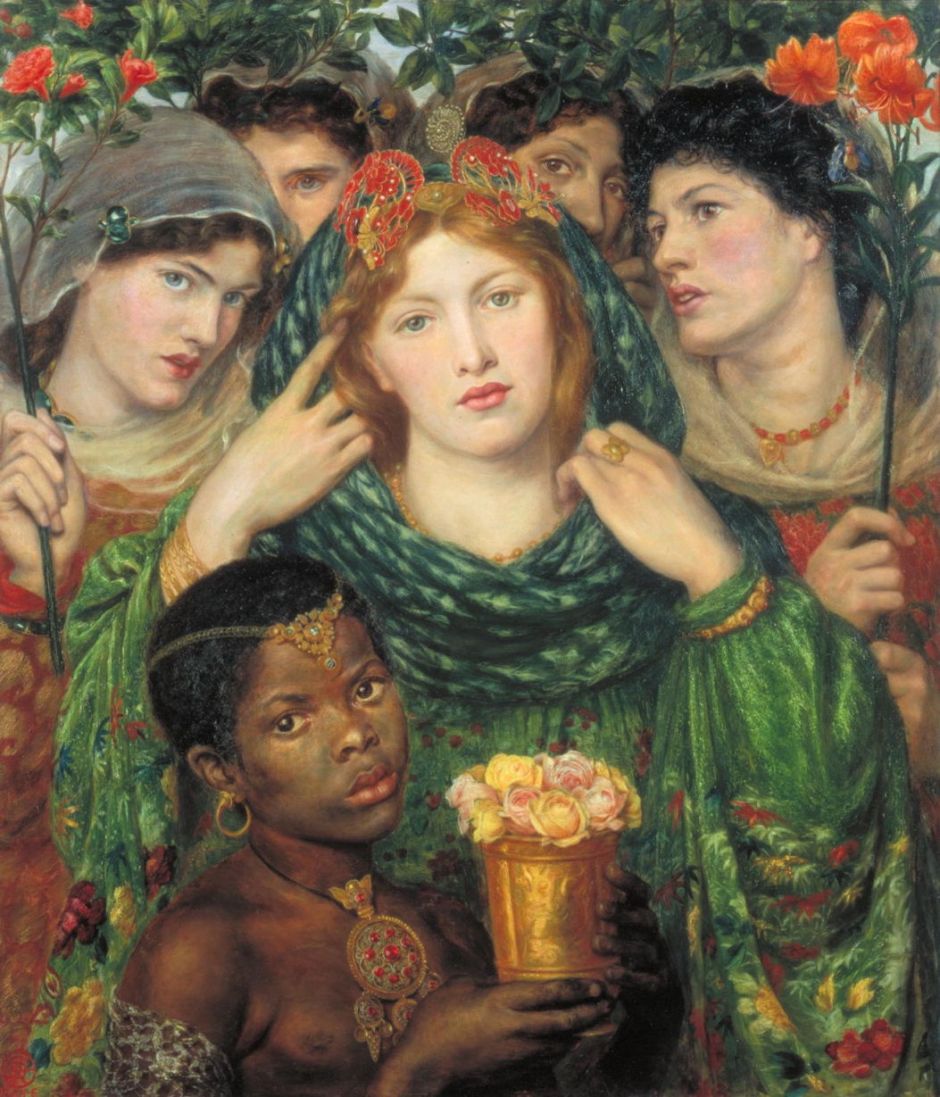
The Beloved ('The Bride') (1865–half dozen) had been deputed in 1863, simply was not finished until early 1866. Originally intended to evidence Dante'south Beatrice, a favourite theme of Rossetti and others at the time, it came to exist based on the Old Testament's greatest honey poetry, the Song of Solomon. Rossetti inscribed its frame with the quotations:
My dearest is mine and I am his. (Vocal of Solomon 2:16.)
Let him kiss me with the kisses of his mouth: for thy love is better than wine. (Vocal of Solomon 1:two.)
She shall be brought unto the King in raiment of needlework: the virgins her companions that follow her shall exist brought unto thee. (Psalm 45 v xiv.)
The helpmate in the centre, modelled on Marie Ford, wears an intricate leather headdress from Peru and a Japanese kimono, although the latter is wrapped around her in an idiosyncratic manner rather than beingness worn as the Japanese garment would have been. Her attendants crowd effectually her, making the composition very shallow, and adding exotic touches in their skin colours and appearance. Its symbols are few and simple: roses (love) being offered upwards by the boy in the forepart, and cerise lilies (passion, concrete love).

Rossetti's later Veronica Veronese (1872) returns to the musical theme of The Blue Bower. Commissioned by Frederick Leyland, a shipping magnate from Liverpool, it was destined for his drove of Rossetti'southward images of women in the drawing room of his Kensington, London, residence.
Its title refers to the Venetian Master Veronese, who together with Titian was now a greater influence on Rossetti than those prior to Raphael. Rossetti also felt that the proper noun sounded like some sort of musical genius. His model was the beautiful Alexa Wilding, who became Rossetti's obsession afterward they met in 1868.
She sits, heedless languidly, her hands playing idly with a violin which hangs on the wall in front of her. She has been writing a musical score, which is under her correct forearm. Although her body leans slightly forrard, her head is tilted back, and her confront turned. Behind her, a yellow canary is perched on the door of its cage and singing, its voice inspiring Veronica's thoughts. The window behind is covered in thick dark dark-green drapes, and Veronica wears a full dark green dress.
Aestheticism and the Aesthetic
Rossetti had inverse his art, to the product of idealised sensual images of women, singly or in groups. These new paintings take elements of (weak) narrative, literary illustration, and portraiture, but exercise not fit any i of those genres.
The best fit for those works is that of the Aesthetic 'motility', or Aestheticism, which was developing during the 1860s. Among its architects was Walter Pater, who claimed that "all art constantly aspires towards the condition of music", in its abstraction, lack of narrative or 'meaning', and capability of generating powerful emotions in the listener.
Although some of his merits is debatable with respect to painting in full general, and Rossetti's subsequently paintings in particular, information technology does fit well in many respects: allusions to non-visual sensation and other creative modes/media, shallowness in reading and pregnant, and overt sensuality, for case. Failing to draw a stardom between Rossetti'southward early PRB paintings and these later works would surely exist a adequately gross mistake.
References
Barringer T (1998, 2012) Reading the Pre-Raphaelites, revised ed., Yale UP. ISBN 978 0 300 17733 6.
Prettejohn E (2007) Art for Art's Sake: Aestheticism in Victorian Painting, Yale UP. ISBN 978 0 300 13549 7.
Source: https://eclecticlight.co/2016/10/15/dante-gabriel-rossetti-the-pre-raphaelite-and-aesthetic/
0 Response to "Reading the Pre-raphaelites: Revised Edition 2012 by T. J. Barringer"
Post a Comment