The End of the World Again Comic
Reviews
Only the End of the World Over again
I. True Story. Back before Neil Gaiman became a brand, he complimented my wife'southward evening apparel at a gathering of bookish nerds existence held at the Marriott Fort Lauderdale Airport. The clothes featured cutouts which brought to Mr. Gaiman'southward mind, "something out of Star Trek," a loftier bar of 'nerd' praise for sure. The remainder of the evening went unremarked, its apex having been reached.
***
II. This is the third time Only the End of the World Again—yet another of Neil Gaiman'southward riffs on H.P. Lovecraft—has constitute purchase. Phone call this current iteration, the latest entry into Dark Horse'southward 'Neil Gaiman Library,' what it is: a beautifully designed cash grab.
Such a flip assessment should non (and does not) extend to those creators who, rightfully and so, find their names lower on the marquee. Comic pros have to pay rent too. And so Bravo indeed to Messrs. Russell, Nixey, Hollingsworth and Konot. At present, earlier toppling off as well high of a equus caballus, let's acknowledge that this is Dark Horse Comics Books, a smallish fish swimming in the mid-sized pool of the popular civilization landscape called Comics, a dense—and if the multiplexes are any arbiter of taste—nutrient rich stew stocked to the gills with many intellectual properties ripe for (re)adaptation.
Only the Stop of the World Again was commencement released in black and white by Oni Press in 1998'due southŌni Double Characteristic #half dozen through #8. Oni also put out a subsequent edition--thin as gruel. So thank the elder Gods then Dark Horse coughed up the cash for Hollingsworth to add together his jaundiced shades of blue-greens and greenish-blues to a story set in the lonesome quondam town of Innsmouth, Massachusetts. Yes, yes as if this thrice-told-tale needed to swap in one more sorta' new lamp for quondam, OtEotWA firmly resides in that particular corner of the prima shared fictional universe, the Cthulhu Mythos.
The fact that such a beneficial slice of ephemera exists—and is on its third go circular no less—says more about the ability of Gaiman's brand than perhaps anything else. To go further and devolve like an upstanding Innsmouth-ian into downright nihilism, readers are being asked to, in one case again, purchase something they already love that's been cobbled together from other stuff they also love as well. Reprints gonna reprint!
So where does that leave the consumer reader? New work from Hollingsworth that's easier got for far less filthy lucre in a recently published pamphlet? Yes and no. Merely the End of the World Again represents a study in what it means to be a comics pro. Like some Ghost of Christmas Present, Gaiman et al. swish bated their Dickensian robe to reveal the sins of competency and consistency. Everyone wants to pose as punk and ragged—specially in the august ones and zeroes of 'TCJ.' Gaiman wanted the same thing when he was poolside in his blackness motorcycle jacket in the Florida oestrus. True Story. Whiter the professional, the ace, the old hand? When did professionalism turn uncool?
3. Gaiman is perhaps the best bricoleur, certainly one of the nigh popular, working today; a author who made his basic with equal parts innovation and inheritance. When it comes to improving and improvising on other people'south ideas, he's Shakespearian . Everyone does it and Gaiman does it better than most.
In Merely the End of the Globe Again he brings an insurance adjustor (go information technology?, adjustor?) past day and a werewolf by nighttime to Lovecraft's Innsmouth. Lawrence Talbot—Gaiman borrows the name from Lon Chaney Jr.'southward character in 'The Wolf Man' which in doing so nips a clever conceit from Gaiman's spiritual mentor Roger Zelazny's A Night in the Lonesome October—is in town, and plainly has gone so far as to set up a business organization at that place, for reasons … because [shouting] THIS! IS! INNSMOUTH! A lycanthrope … in Cthulhu'due south BAE town ... what else do you lot need or want? Torches volition blaze, aboriginal chants praised and there will be tentacles, teeth and all that deep, dark, dank water and (yes) at least one underwater eldritch edifice, preferably dark-green, will be, at least, glimpsed.
 Gaiman never overthinks or questions. Aside from demonstrating the ingrained xenophobia common to all Innsmouth inhabitants, Gaiman is non in town to praise or raze Lovecraft's odious personal politics. Like his protagonist, Gaiman has been sent to practice a task, he does information technology competently and completely with enough wit to gear up Lovecraft lovers swooning with the utilise of words like "Dagon" and "Manuxet." Only the End of the Earth Again blows your hair back in its efficiency and skill, not because Gaiman had some 'woke' take twenty years ago on the O.G. MAGA schlockmeister. If he had, maybe this IP wouldn't take been only refreshed three times in twenty years or worse, not at all. If he had or if others since had washed more to phone call out Lovecraft's racism maybe we wouldn't notwithstanding have to talk about why Mythos flagbearers don't deal with Lovecraft's racism.
4. Remember of the creators of Only the End of the World Again as the coiffure in a heist movie, something slick, professional person, possibly French or with some 70s ersatz grit. Similar if the ex-cons of 'Rififi' or 'The Sting' got together and made a comic volume. If so P. Craig Russell would play the safe cracker extraordinaire Cesar in 'Rififi' or Paul Newman's Gondoff in 'The Sting.' Any constitutes adaptation and layouts in OtEotWA, Russell's pedigree has him punching below his weight class. Likewise having won plenty comics industry awards to choke a kraken, Russell is adaptor rex having lent his talents to works past Moorcock, Bradbury, Wilde, Kipling and previously with Gaiman.
 To pad out a fifty plus page story Dark Horse includes said layouts alongside high res scans Troy Nixey's finished pages and therefore triples the story'south original page count to justify (?) this edition. Again, that'south too cynical by half. This isn't sausage making or bellybutton gazing, information technology's an exemplar of how work gets washed. Adaptation makes for a catchy business, if successful the praise goes to the source textile—well, you lot should read the book!—if done poorly or so slavishly as to leave itself a flaccid glop of blah—well, y'all should read the book! There's trivial to exist won (or lost) with adaptations for those who do the adapting. What makes the difference here is one give-and-take: 'Gaiman.' It'south a near guarantee Only the End of the World Again gets read or ameliorate even so, fix in a place of prominence in a bookstore or LCS. With the exception of accountants and collectors, Comics is synonymous for disposable. In spite of his longtime collaboration and shared success with Gaiman, Russell will never receive the same credit or be as well remembered as Gaiman. It'southward a shame, but it's all in the game. The unproblematic fact this werewolf past way of Lovecraftian horror obscura has any viability in the marketplace is because it bears Gaiman's proper name.
Take time to pore over what Russell lays out, how the eye tracks from one console to the adjacent and on to the adjacent. Even at this rudimentary stage, the realization hits that you are in thrall to a master craftsmen. Little details similar how staircases stop at the lesser right side of a page or spiral nearly foreshadowing the mad tentacle terrors to come. Russell makes it all feel like the reader is just following a character as he crosses from one threshold, ane folio to the side by side.
If casting determines a film's success than Russell and Gaiman chose wisely recruiting Troy Nixey to the squad. There'due south a built-in squishiness to all things Lovecraft that is both cliche and endemic. So also is the case with Nixey'south fine art. He draws Talbot's face up as if someone tried to pull the optics down closer to the mouth, but lost their nerve halfway through which leaves him with more forehead than mentum. Talbot's nose alone approaches the sublime, an illustration of some cabalistic knot that's been mashed into a child's cartoon of a sideways bird. Nixey's cartooning has a caricaturist style sans the goofiness that comes with the merchandise. Again, think professional. Think of Hirschfeld and Herblock having a babe.
Only faces aren't what grab eyeballs in Lovecraft-inspired yarns—not, you know, artistically speaking. Nixey's 'Deep Ones' are vulgar without being extravagant and repulsive without being romantic. The word rasp-like comes to mind. Besides existence blatantly racist, Lovecraft wrote the book on how words fail to describe the ancient horrors of deep infinite or deep water. And so information technology'south been left to the artists to render where HPL demurred. Like Gaiman and Russell do with the words and story, Nixey chooses to make his waterlogged abominables higher up average, but not nightmare fuel—pleasing taste, some monster-ism.
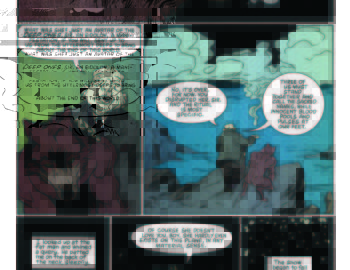 The same goes for Talbot'due south hairier and toothier one-half. Nixey drafts a wolfish werewolf without going besides far in either management, neither fauna-man nor human-beast. This balanced approach appears in full when the baddies have slipped back beneath the waves and all that's left is the wolf and a witness. Nixey draws a perfect canine caput, textbook, and fills the full top tertiary of the page with it. Tucked below, Russell lays out two panels that allows Nixey to button the wolfman into the foreground equally it leans its caput out over its humanoid trapezius towards its interlocutor. In the bordering console the perspective changes, the view is now from in a higher place, as if this leaning lupus has already taken the reader over the border of the cliff it and its human counterpart stand upon below the primeval pitch blackness and all that Nixey-ian inky nighttime.
***
5. My anecdote well-nigh Neil Gaiman complimenting my wife at a hotel conference center near an airport in Florida isn't the kind of story one dines out on. When it's remembered and remarked upon information technology'due south met with the sort of politeness that'south shown to most stories most brushes with celebrity. Charming. Inoffensive. The same two words describe the claim and essence of Only the End of the Globe Once more. Gaiman, Russell, Nixey, Hollingsworth and Konot don't interruption barriers or upend expectations, instead they deliver on their promises because they're professionals. If you lot do spend either time or coin on these past masters, no worries, it's not like it's the stop of the world … again.
Source: https://www.tcj.com/reviews/only-the-end-of-the-world-again/
0 Response to "The End of the World Again Comic"
Post a Comment