The Most Commonly Used Kind of Paints in Fine Art Applications Since the Time of the Renaissance Is
There were 3 principal painting techniques during the Renaissance: fresco, tempera, and oils. In all of these techniques, color was an of import part of the painter's armoury, assuasive them to create images that would strike a chord of recognition and pull a gasp of awe from the viewer. While many artists were skilled in all 3 techniques, as the Renaissance wore on, fresco was reserved for ceilings, tempera for small religious panels, and oils for wood panels or canvases, sometimes very large ones. Oils permitted much greater subtlety in execution and became the favoured medium of near late Renaissance masters, a preference that would continue in the following centuries.

Colour Detail of The Madonna with Catechism van der Paele
Renaissance Colours
A wide range of colours was available to the Renaissance creative person, simply quality and brightness depended on the size of their bag, or perhaps more accurately, that of their patron. Colours were fabricated from earths and minerals. Lakes were colours made from organic material like plants, flowers, and berries and were relatively cheap and easy to acquire. Metallic and mineral-based pigments were more expensive. Lead was used to make white and red, tin can or orpiment for xanthous, azurite for blue, and malachite for dark-green. An creative person or his supplier might take to visit a port like Antwerp, Bruges, or Venice, which had trading links beyond the Mediterranean and Asia, in order to acquire the rarer and very best pigments. The only source for ultramarine, for example, was lapis lazuli from Transitional islamic state of afghanistan. For this reason, commission contracts often specified limits on certain materials so that the finished work of art remained within the ways of the patron.
Mixing pigments with the correct corporeality of liquid medium to achieve the luminosity & texture an creative person required was a task that required feel.
Pigments were available from merchants, apothecaries, and monasteries. Prices likewise varied depending on the course and colouring of the raw fabric but we accept many artist's account books to determine what price what, where, and when. To compare colours and materials, 28 m (1 oz) of ultramarine (and so sometimes called azur of Acre) cost four francs in Dijon in 1389 CE, plenty to buy 3.6 kg (8 lbs) of vermillion, 7.2 kg (16 lbs) of lead white or 300 sheets of very fine gilded leaf. Information technology is perhaps understandable, then, that many artists, instead of ultramarine, used azurite, which was ten times cheaper (but less intense). Very deep or intense reds were another expensive addition to an creative person'southward palette. These were made from the crushed scales of insects like the kermes protrude. Once more, a much cheaper merely less colourful culling was available, this fourth dimension ground madder root.
Information technology is not perhaps surprising that these expensive commodities were one of the major assets of a workshop. Indeed, artists ofttimes left their pigments to relatives in their wills. Many artist guilds insisted, too, that certain pigments non be used in certain media. This ensured a distinction of high quality in panels, for example, and meant that a copyist could not laissez passer off a painted slice of cloth equally equal in value to a panel; the two would not have had the same colouring. In addition, this also reserved certain of the best materials for those artworks intended for a higher purpose such as altarpieces and other artworks destined for churches.
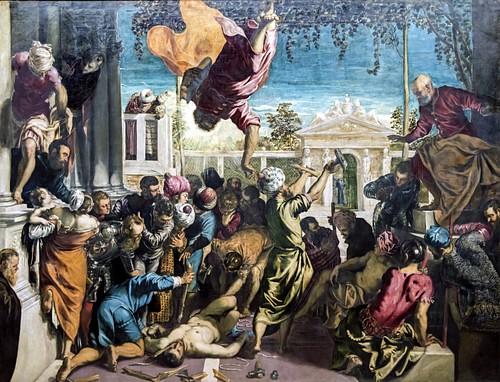
Miracle of St. Mark by Tintoretto
Once acquired, pigments were footing on a stone slab - preferably something non-porous like marble - using a cone-shaped stone known equally a muller. Producing a fine powder was a laborious task, just it was not without some skill. Too fiddling or as well much grinding of certain pigments did not achieve their optimum colouring. So mixing pigments with the correct corporeality of liquid medium to achieve the luminosity and texture an artist required was some other task that required feel. Both written records and paintings of workshop scenes attest that paint preparers were specialised members of a workshop and not, as is often claimed, young apprentices.
The use of bright colours became especially popular in Venice where the technique of colore (aka colorito) was popular, that is using the juxtaposition of colours to define a composition rather than lines. Titian (c. 1487-1576 CE) and Tintoretto (c. 1518-1594 CE) were famous exponents of this technique. However, some artists and, presumably, therefore, clients, preferred more than subdued colouring for certain subjects, for example a painting showing the decease of Jesus Christ or a saint.
Jean Lemaire de Belges wrote the following verse in his La Couronne Margaritique (c. 1505 CE), a description of the typical paraphernalia in an creative person's workshop:
Their studio is full of panels
Some painted, some to be painted, and many noble tools.
There are charcoals, crayons, pens, fine brushes
Bristle brushes, piles of shells
Silverpoint, which makes many subtle marks
Polished marbles, every bit vivid as beryl.
(Nash, 157)
The polished marbles are surely the stained marble slabs used to grind the pigments. The shells described above, typically mussel and oyster shells, were used to keep the footing powder in until needed by the artist. Brushes were either made by the creative person or bought readymade in diverse sizes. In that location were two categories of hair brushes: pig/hog or squirrel/fox. Size varied depending on the task but ranged from fine points of a few millimetres to broad brushes of three centimetres (1.2 in).

The Ghent Altarpiece by Jan van Eyck
Finally, gold, silver, and can leaf were used in pieces made for wealthy clients or important churches. Later Renaissance oil painters were able to reproduce metallic furnishings using oils only precious materials were, in whatever case, sometimes required for prestige pieces. The base panel was prepared with a smooth layer of ground chalk and and then a layer of greasy dark-brown clay over which superthin pieces of beaten gilt, silver, or tin were applied. The preparatory surface dried very quickly and and so to add together metal foliage to a piece and non take any bubbles or wrinkles at the finish was a task for someone with great experience and a very steady mitt. Leafage could then be polished using a tooth or minor shine stone. Sometimes leaf work was punched to create patterns or painted and then areas scraped abroad to reveal the metal beneath, over again to make patterns.
Fresco
The fresco technique has been used past artists always since antiquity, and information technology continued during the Renaissance to be the well-nigh popular method of painting larger surfaces like interior walls in churches, public buildings, and private homes. However, equally oil paintings on large canvases became more popular through the 16th century CE, so frescoes were often limited to the upper parts of walls and ceilings.
True fresco (aka buon fresco) involved starting time covering the wall surface area with a layer of wet plaster (arriccio) which has a consistency coarse enough to act as a binding amanuensis for a 2d, finer layer of plaster (intonaco). The estimate pattern was then drawn onto the plaster, either using a cloth similar charcoal or by placing over the wall a large paper sketch (a 'cartoon') with holes punched in it and then bravado charcoal dust through the holes (pouncing). Charcoal was a useful cloth as it could easily be rubbed out using a finger or a piece of soft staff of life. Alternatively, the outline of the cartoon could be scored onto the plaster using a stylus.
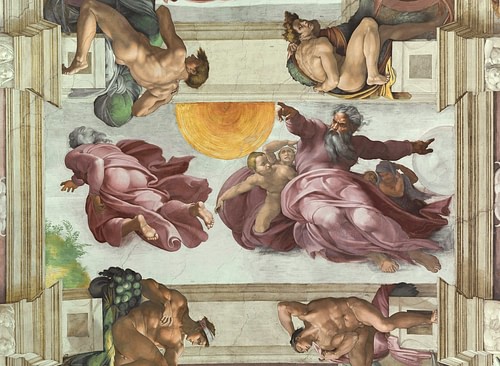
God Creating the Sun, Moon & Planets, Sistine Chapel
Side by side, the artist decided which part of the wall he was going to piece of work on that particular day - typically they worked from the superlative of the wall downwards - and covered it with a very thin layer of fresh plaster, translucent enough to see the blueprint backside it or by redoing that section of drawing using charcoal. The artist was then in a race against time earlier the plaster dried out, usually one working 24-hour interval. As a event of this process, fine art historians are able to place the sequence that pieces of wall were painted and approximately how many days they took to paint.
The problems with fresco included the necessity to work fast & the lack of opportunity to blend colours.
Water-based coloured pigments were so used to paint the final pictures. The colours and plaster dried together, fixing themselves to each other and making it possible for a fresco to concluding for centuries. This is due to the chemical process where the drying plaster creates a coating of carbonate of lime crystals. Information technology is these crystals which coat the paint, not only protecting information technology just making the colours brighter, besides, as the surface dries. For this reason, an artist had to paint using darker tones than really required. Finally, fine details or corrections might then exist added using 'dry' paints (fresco secco). A supreme instance of success using fresco is the Sistine Chapel ceiling by Michelangelo (1475-1564 CE), completed in 1512 CE.
Some artists did try and experiment with this tried-and-tested technique but non with very much success. The problems with fresco were the necessity to work fast, the need to scrape off an expanse and showtime from scratch if a mistake was made, and the lack of opportunity to blend colours like one could in oil painting. Another disadvantage was that frescoes tended to deteriorate badly in damp climates. The most infamous instance of an artist using only 'dry out' paints on a fresco is The Last Supper which Leonardo da Vinci (1452-1519 CE) painted in Milan (a metropolis with high humidity) but which began to crumble away within decades of its completion c. 1498 CE.
Tempera
Tempera is a painting technique which dates back to artifact when it was especially used by artists in aboriginal Arab republic of egypt. It involves mixing colours in fine powder grade with a liquid that acts equally a binding agent, nigh commonly egg yolk mixed with water (egg white can discolour, while yolk loses its color). An alternative was to add together oil to the solution which makes it dry faster and permits awarding to softer surfaces like canvass. A 3rd recipe used white curd instead of egg yolk and added diluted lime juice to the mix.
The reward of creating the colours in this way is that they become much brighter and have a translucent quality useful for edifice up layers of colour in order to requite an image depth and texture. A disadvantage was that colours could not be mixed when applied to the working surface. Consequently, an artist ordinarily practical the darkest shade of a colour first and and then added successive layers or areas of lighter shades.

The Flagellation of Christ past Piero della Francesca
Tempera was near unremarkably applied to gesso or wooden panels. The wood used was mostly pine or poplar in southern Europe and Baltic oak in northern Europe. Forest panels were typically made past a specialist and and so bought by the painter; the same was true for picture show frames. The woods was showtime covered with a layer of thin linen and then a chalk and glue mixture. Equally with fresco, the artist might create a rough sketch on the panel, then cover this with a polish translucent layer of mostly oil, and then fill up in the design using tempera colours. The Flagellation of Christ by Piero della Francesca (c. 1420-1492 CE), created c. 1455 CE, is an case of tempera on panel painting, although Piero was something of an experimenter and sometimes mixed tempera colours with oil colours.
Oil Painting
Oil paints were fabricated from powdered pigments added to oil, most oft linseed oil, but sometimes others like walnut oil, which was especially good at making white more luminous. Some artists heated the oil before apply as this made the paint less likely to shrink and crevice when it dried.
The Netherlandish creative person Jan van Eyck (c. 1390-1441 CE) was traditionally credited with inventing the oil painting technique but it was, in fact, a much older method that had but fallen out of favour with artists. Van Eyck was given this honour probably because he was the undoubted master of oil painting and he was one of the first Renaissance artists to regularly employ oil paints in his work. By the end of the 15th century CE, nigh major Renaissance artists in the Low Countries and Italia, particularly, used oil paints when working at an easel, not tempera.
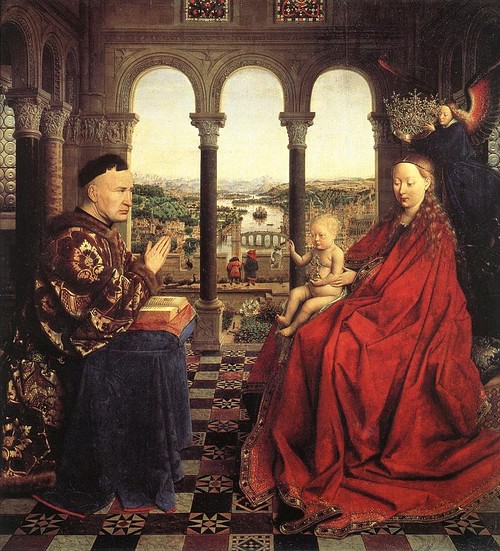
The Virgin of Chancellor Rolin by Jan van Eyck
Oil paints were versatile and could be applied to prepared wooden panels, canvas, paper, fabric, or a wall surface. A primer layer of white or very lite grey was typically applied to the surface before painting began proper. So various layers were applied with the artist unremarkably starting with the background, then peripheral elements, next clothing and draperies, and finally hands and faces. The rich colours oil paints offered were ideally suited for the brocaded clothing, costly drapery, and sparkling jewels that were stylish at the time. Such were the possibilities of oils that, as mentioned higher up, even metallic materials made with gold and silver could be rendered without the need for gold and silver leaf.
Oils allowed for a much greater subtlety in colours considering translucent colours can be variously layered or coloured areas tin can exist composed of layers of varying thickness of pigment, thus creating a very broad range of color tones. Assay of Renaissance paintings has revealed that there are frequently up to seven different layers of paint in any one area. Further, brush strokes using oils can become invisible or they tin can be used for effect, the artist deliberately varying their size, shape, and direction. A outcome of this layering and variation in brushwork was the achievement of real depth in a painting that tempera panels or frescoed walls could not friction match. Then, too, details similar skin texture, pilus, and wrinkles, as well as optical effects like reflections, could at present be represented as never before. Some other slap-up reward is that oils can take several days to dry out and this allows the artist to mix, alloy, adapt or completely rework an expanse of his painting (fifty-fifty using their fingers to do and so). Further, any mistakes tin can be covered over with extra layers of paint once the original layers have dried. No wonder, so, that oil painting is nonetheless the kickoff choice of fine artists today. Once finished, a Renaissance oil painting was usually given a thin layer of protective varnish to ensure the work lasted far across the lifetime of its creator.
This article has been reviewed for accurateness, reliability and adherence to academic standards prior to publication.
Source: https://www.worldhistory.org/article/1628/colour--technique-in-renaissance-painting/
0 Response to "The Most Commonly Used Kind of Paints in Fine Art Applications Since the Time of the Renaissance Is"
Post a Comment